
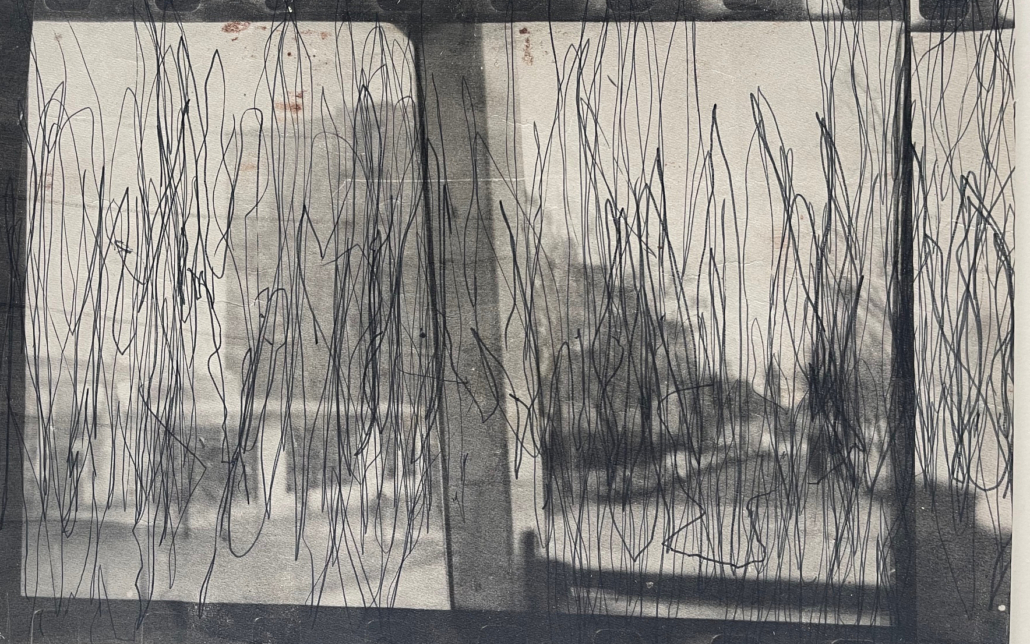
Who passes the window?
A new Essay by Brian Dillon.
Published in the catalogue “Beyond Photography” by Edition Dittmar, Berlin,
to accompany the exhibition “Beyond Photography” by Katja Liebmann,
Galerie Dittmar, Berlin, 28 April – 25 June 2026.
If photography had never been invented, we might be dreaming of it still when we look through windows into the street, through car windscreens or out from our seats on buses, trams and trains.
Each of these is an apparatus for making images, the city becoming indelible even as it quickly vacates our vision.
What else is a London bus in 1922, when Virginia Woolf published Mrs Dalloway, than a camera barging through the busy streets, making the novel’s protagonist super-sensitive to all she sees?
“Clarissa once, going on top of an omnibus with him somewhere, Clarissa superficially at least, so easily moved, now in despair, now in the best of spirits, all aquiver in those days and such good company, spotting queer little scenes, names, people from the top of a bus, for they used to explore London and bring back bags full of treasures from the Caledonian market—Clarissa had a theory in those days—they had heaps of theories, always theories, as young people have.”
But despite the voraciousness of this vision in motion, the city also gives itself to us half hidden, smeared by movement, by rain or dirt, by the transience of the gaze we bring to bear on it.
In the photography of Katja Liebmann, we are always looking at the world through more or less alluring veils.
There is the alchemy of photographic processes that will soon be two centuries old, the blurring or distorting effects of cheap, simple camera and lenses, the Plato’s-cave shadow realm of the camera obscura, and a variety of textured supports for the finished image.
Also, the frames and surfaces that inside the image will isolate or mystify for us the thing itself, whether object or atmosphere.
Nowhere more so than in Liebmann’s photographs, from the late 1980s to the present, of certain cities. Berlin, London, New York: they appear quite recognizable but occluded, their views and local details transformed or half hidden behind overlapping images, streaming windows, the swarming grain or imperfect resolution of “primitive” techniques and technology, magazine pages that might be the “real” thing.
Liebmann’s work, especially her photographs from the 1990s and early 2000s, smears distinctions between photography and painting, photography and drawing, photography and printmaking, perhaps even photography and writing.
Here cities are spectral reminders of themselves, of their histories and their histories of image-making. In more recent pictures, a similar operation is carried out on land, sea and weather.
In early photographs taken in Berlin—pictures made when the artist, trained in typography, painting and printmaking, was looking at a city newly available to itself—the static view of the place lives on the same plane as a record of the artist’s movement.
Travelling around the city on public transport, Liebmann, as one may expect, took photographs through the windows; at times the frame is in focus, on other occasions the street outside.
As Liebmann puts it, “I like the idea of looking at an image as if looking through a window—and vice versa.”
Among the first things that the nineteenth-century inventors of photography did was to point their machinery at windows—consider Nicéphore Niépce’s View from the Window at Le Gras (1826) or William Henry Fox Talbot’s Oriel Window, South Gallery, Lacock Abbey (c.1835)—so that one is reminded always, at its very origins, of the medium standing between the viewer and the thing itself. (In Fox Talbot’s image, there is nothing but the window frame.)
But here there is more than one medium at work: Liebmann travelled with an etching plate and stylus, whose scrawls registered each lurch or turn of bus or tram, and are superimposed on the picture. In Liebmann’s telling, however, she herself was the medium; the stylus and camera are extensions of a body moving through city space.
And one has the same impression in other strands of her work in Berlin: in images run together by a basic camera into long strips, or travelling shots of the city’s bridges, blurred and streaked as she passes.
Some of Liebmann’s earliest photographic works place her own face against the city’s almost theatrical backdrop: the artist on her balcony in Berlin, for example. In New York City, later in the 1990s, she appears in a sleek Batman mask against the towers of Manhattan.
The Gotham City series is of course a sly revision of the pop mythology of the male superhero. But it is also a project peculiarly out of time.
New York in these pictures is less the gridded modern city of ambitious verticality, and more a vertiginously angled Expressionist stage set, with Liebmann having something in common with the masked criminal genius Fantômas—in early-twentieth-century novels and comic books by Marcel Allain and Pierre Souvestre—who prowls Paris by night, a proto-Surrealist figure who sees into the dark secret heart of the city.
In the London Ornament and Berlin Ornament series, she is perhaps the daylight version of this haunting persona: a ghost who looms in the foreground of views of city streets, shopfronts, bristling expanses of text in the form of signs and advertisements.
In Liebmann’s imagery, a familiar touristic locale such as Piccadilly Circus becomes a blurred and glitchy dream of itself, superintended by an artist-spectre.
And then there are the houses, the facades, whose blank windows may be observing us, both viewer and artist.
In Liebmann’s cyanotypes depicting terraced London houses and Berlin apartment blocks, everything seems on one level ordered and rectilinear, the uniformity of residential urban frontage turning the city, or these paradoxically unpeopled parts of it, into a series of flat blue planes interrupted by dark squares and rectangles of glass.
(Something similar happens in a lot of Eugène Atget’s photographs in the early decades of the twentieth century: Paris becomes a city of surfaces and holes.)
But the effect of these purely vertical exteriors, without horizon or depth, is actually to evoke an idea of interiority, both architectural and mental.
The blue of the flat image and aspect becomes the blue of distance. Liebmann’s blurred, overlapping or seemingly double-exposed pictures give us nothing more or less than the image of imagination.
Though photography and the railway are roughly contemporary inventions, and the view from a moving train quickly becomes in the nineteenth century a defining experience of modernity, the two technologies do not immediately meet: many decades must elapse before film is sufficiently fast to capture land and cityscapes at speed.
In the meantime, the train carriage is itself a kind of camera, with another apparatus inside it: the eye and imagination of the traveller.
Perhaps it is because for so long it was so hard to photograph that looking through a train window came to seem a dreamlike or Romantic activity rather than a jarring, abrupt or shocking one.
In Woolf’s 1931 novel The Waves, London is transformed by the view from an approaching train: “‘How fair, how strange,’ said Bernard, ‘glittering, many-pointed and many-domed London lies before me under mist. Guarded by gasometers, by factory chimneys, she lies sleeping as we approach.
She folds the ant-heap to her breast. All cries, all clamour, are softly enveloped in silence. Not Rome herself looks more majestic. But we are aimed at her. Already her maternal somnolence is uneasy. Ridges, fledged with houses rise from the mist.
Factories, cathedrals, glass domes, institutions and theatres erect themselves.”
Look at Liebmann’s cyanotypes of indistinct landscapes behind rainy and in-focus windows, and one feels transported out of time, into the interior space of memory and anticipation.
In June of 1932, Woolf published in The Yale Review an essay worked up from a letter she had sent to the poet and publisher John Lehmann. “Letter to a Young Poet” is full of advice and opinions about the rhythm and the liberty of writing, and warnings against caring what others think.
It also conjures an image of the modern writer as someone who looks through a window into the street and describes what he or she sees, the ordinary things of daily life, such as bicycles and buses:
“All you need now is to stand at the window and let your rhythmical sense open and shut, open and shut, boldly and freely, until one thing melts in another, until the taxis are dancing with the daffodils, until a whole has been made from all these separate fragments.”
The things themselves, and the people who walk by, make up just one strain of this windowed view of the world.
The other side of it is in Woolf’s verbs rather than nouns: the opening and closing like a camera shutter, the melting and the movement that blurs the world as it passes.
And surely blurs the writer, or the artist, too: in Liebmann’s work, you have the sense always of the photographer herself as a presence just as enigmatic and vacillating as the buildings, streets and landscapes she photographs.
As Woolf puts it, “There is a fixity, a gloom, yet an inner glow that seem to hint that you are looking within and not without.”
Brian Dillon is an Irish writer based in London. His books include Ambivalence, Affinities, Suppose a Sentence, Essayism and In the Dark Room.